
This is the first of a six-part email series for oral health professionals about BCCOHP’s Standards for the Oral Health Team (Standards) which came into effect on June 30, 2025.
Watch for these emails in your inbox every week for the next six weeks.
The Standards are organized by six overarching principles, which underpin ethical decision-making in oral health care.
- Put the patient’s interests first
- Provide safe and competent care
- Be culturally aware, equitable and inclusive
- Communicate effectively and obtain informed consent
- Collaborate in the patient’s interest
- Build and maintain public trust
This email series is designed to help oral health professionals understand the professional standards more deeply by highlighting and sharing additional resources related to each of the six principles over a number of weeks, starting with principle 1.
Principle 1: Putting the patient’s interests first
As an oral health professional, you have a responsibility to ensure you are putting the health needs and well-being of your patients before any other considerations.
Learn more about principle 1 by watching this short video >>
Q&A: Principles in practice
Since the Standards came into force on June 30, 2025, our team of professional advisors have received a variety of questions. We are sharing two of the most frequently submitted questions related to principle 1.
The answers shared below should be considered in combination with professional discretion and individual patient needs. Our standards are not designed to be exhaustive, and BCCOHP sets expectations through high-level, broadly stated principles. A principle-based approach gives latitude to the oral health professionals we oversee to make decisions that provide safe care to patients.

Question 1: How do I consider care for family members or others with whom I have a dual relationship?
Answer: According to standard 1.3 “You must identify and address conflicts of interest when treating family members and those with whom you have a dual relationship to ensure you provide safe, objective care.” Sections 1.3.1-1.3.5 outline how to meet this standard, including that you must consider how the relationship may affect your objectivity, disclose and address real or perceived conflicts, ensure the patient’s autonomy and ability to make informed choices, consult with other professionals when possible, and offer referrals if needed. This is addressed on page 17 of the Standards.
Question 2: How do I ensure continuity of care (e.g., during an absence from practice or patient dismissal)?
Answer: According to standard 1.8 “You must support your patient’s continuity of care.” Sections 1.8.1-1.8.3 outline how to meet this standard, including that you must make alternative arrangements to manage your patient’s care when you are unavailable or unable to treat them, inform and support patients if you cannot continue treatment, keep clear records, and communicate clearly with colleagues. This is addressed on page 18 of the Standards.
New! Printable poster for your office
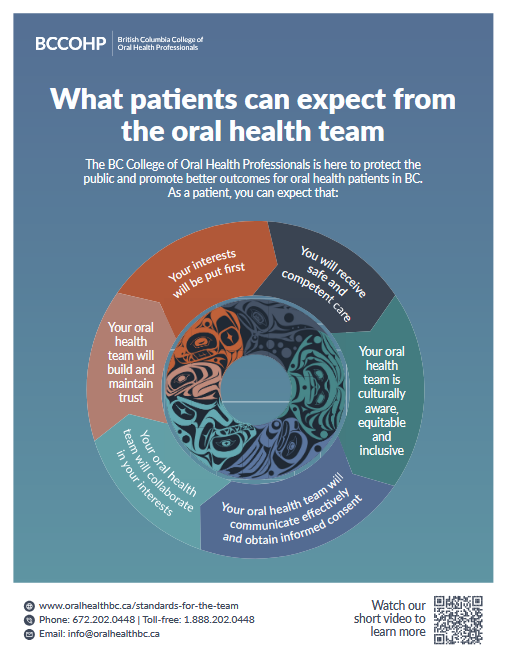
We’ve created a patient-facing poster informed by the Standards explaining what patients can expect from their oral health team. As oral health professionals, you are welcome to print and share it in your offices.
Learn more >>
Background
BCCOHP’s Standards for the Oral Health Team came into effect on June 30, 2025. These standards are the minimum requirements for professional and ethical performance, conduct and behaviour for oral health professionals in BC. They are the core professional and ethical requirements and apply to all aspects of oral health care and all oral health professionals.
Contact us
For more information, please reach out to BCCOHP’s Professional Advisors via our contact form >>