Quality Assurance Program

One of the three main ways BCCOHP protects the public is by ensuring that all regulated oral health professionals are supported in the provision of safe oral health care throughout their careers. This work is carried out through our Quality Assurance Program (QAP). 

BCCOHP has established a single, modernized QAP for all oral health professionals. A detailed introduction to the QAP is below. 

Introducing BCCOHP’s Modernized Quality Assurance Program

The single, modernized QAP replaces all pre-existing programs.  

  • For this first year, the QAP runs from April 13, 2026 to March 31, 2027. 
  • Beginning the following year, the QAP will run annually from April 1 to March 31. 

 The launch of the modernized QAP is in alignment with the recent implementation of the Health Professions and Occupations Act (HPOA). 

Oral health professionals will have received instructions via email and can log into their dashboard at any time.

Program overview 

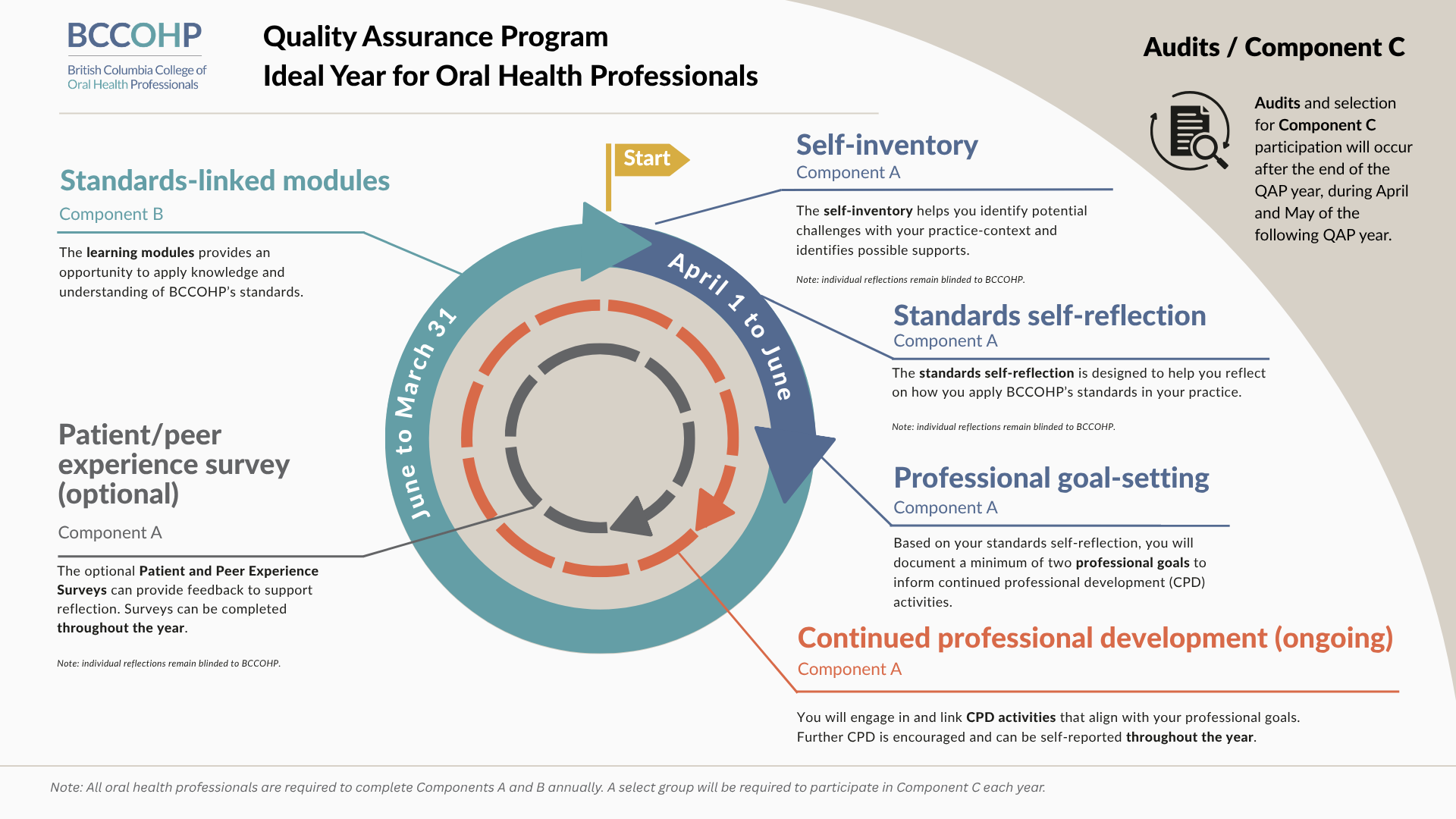
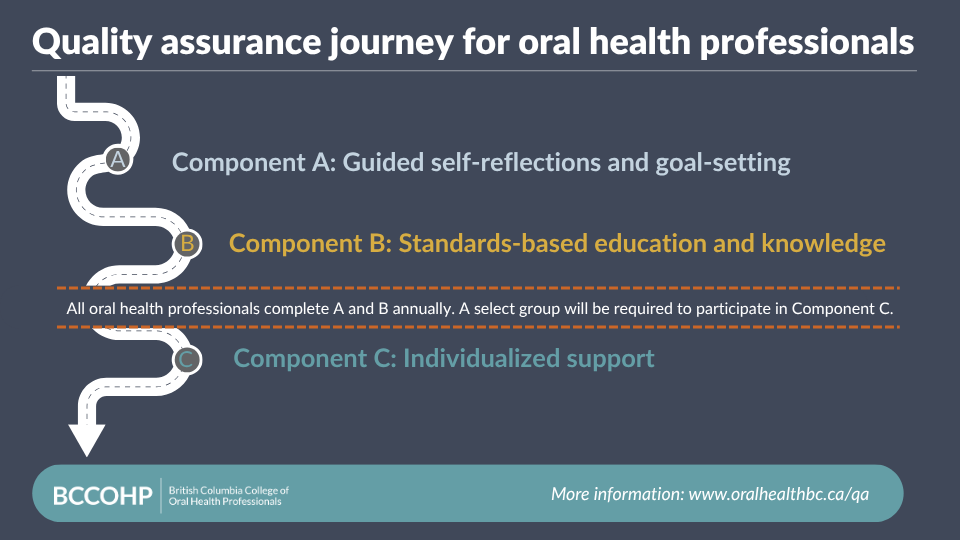
The QAP has three components that work together to create a clear, supportive, and proportionate approach to ongoing competence: 

Quality Assurance Journey map. The components are explained below.

Details for each component of the QAP are below. Expand each section to learn more.

Purpose: Component A establishes the foundation of the QAP and assists oral health professionals in understanding their current professional performance and compliance with BCCOHP’s standards, while providing initial supports to guide professional goal setting and action planning. This component promotes proactive reflection and shared responsibility for maintaining competence.

Frequency: Annual

Format: Online

Elements:

  • Self-inventory (short and connected to practice-context, intended to identify relevant supports)
  • Standards self-reflection (based on BCCOHP’s Standards for the Oral Health Team)
  • Documentation of 2-3 professional goals
  • Self-report of continuing professional development activities (not quantified by hours or credits); instead linked to learning needs and practice context (professional goals)
  • Optional patient/peer experience survey

Purpose: Component B provides oral health professionals an opportunity to strengthen their ability to interpret and apply the BCCOHP standards which support the delivery of safe oral health care and aims to:

  • Promote consistent understanding of BCCOHP’s standards across all oral health professions.
  • Reinforce the link between BCCOHP’s standards and everyday practice.
  • Provide a structured opportunity for oral health professionals to confirm their understanding of BCCOHP’s standards.

Frequency: Annual

Format: Online

Elements:
Scenario-based learning modules designed to help reinforce BCCOHP’s standards across practice settings. Modules* contain:

  • Review of select principles for oral health care and practice standards
  • Interspersed knowledge check activities

*BCCOHP anticipates that no more than three modules will be required each year.

Purpose: Serves as an individualized support-based follow-up within BCCOHP’s QAP. While only a portion of oral health professionals will participate, it plays a vital role in maintaining the integrity of the program by ensuring that those who may benefit from additional support receive it through fair, standards-based, and right-touch processes.

Frequency: Each year, selected oral health professionals will be required to complete Component C.

Format: Online, telephone, or in-person (as indicated)

Selection process: Oral health professionals are identified to participate in Component C via an audit process designed to determine those who may benefit from individualized support. Initially this may include:

  • Non-completion of Component A and/or B requirements.
  • Random audit selection.

Elements: This component is designed to provide an individualized, supportive process for those who may benefit from additional guidance to help them meet BCCOHP’s standards. Elements include:

Self-assessment: This is a brief BCCOHP standards self-assessment.

Tailored follow up: If further assistance is determined to be beneficial, an oral health professional may be assigned to a QA Assessor for the following:

  • Review and discussion to receive tailored follow-up and support based on completion and engagement with Components A and B
  • Co-development of professional goals and an action plan aligned with identified areas in practice
  • Final recommendations from a QA Assessor

Continuous professional development (CPD)

Under the modernized Quality Assurance Program (QAP), oral health professionals will still be expected to engage in ongoing professional learning. Although the program is no longer based on reporting a set number of credits or hours, the expectation to participate in meaningful learning remains the same. 

Within the new program, oral health professionals will reflect on the Standards for the Oral Health Team while identifying goals for ongoing professional learning. From there, the program provides flexibility to use your professional judgment to choose learning that is most relevant to your practice and to determine the type and amount needed to maintain competence. Oral health professionals are encouraged to continue engaging in professional development that: 

  • ensures patient safety 
  • upholds professional responsibility   
  • maintains professional competence

Professional Standard 2.7 requires oral health professionals to maintain current knowledge, skills, and abilities. To meet this standard, you must demonstrate that:  

  • 2.7.1 You remain current and keep your knowledge, skills and abilities up to date throughout your professional career  
  • 2.7.2 You use your professional judgment and reflect on patient outcomes to identify potential gaps or deficiencies in your knowledge, skills and ability and take steps to address them 

Questions? 

A detailed set of questions and answers about the modernized QAP is being maintained here. Last updated April 1, 2026.  

Please email qualityassurance@oralhealthbc.ca.