
This is the second in our six-part series for oral health professionals about BCCOHP’s Professional Standards for the Oral Health Team (Professional Standards) which came into effect on June 30, 2025.
The Professional Standards are organized by six overarching principles, which underpin ethical decision-making in oral health care. This email series is designed to help oral health professionals understand the Professional Standards more deeply by highlighting each of the six principles over a number of weeks.
Please refer back to the communication sent on November 6 for information regarding principle 1.
Principle #2: Provide safe and competent care
As an oral health professional, you have an ethical responsibility to provide safe and competent care to your patients.
Learn more about principle 2 by watching this short video >>
Q&A: Principles in practice
Since the Professional Standards came into force on June 30, 2025, our team of professional advisors have received a variety of questions related to principle 2. We are sharing three of the most frequently submitted questions related to principle 2.
The answers shared below should be considered in combination with professional discretion and individual patient needs. BCCOHP sets expectations through high-level, broadly stated principles which give latitude to the oral health professionals we oversee to make decisions that provide safe care to patients.
While today’s email is focused on questions where the answer largely relates back to principle 2, it’s important to recognize other principles may be relevant in the responses.

Question 1: How can I ensure safe practice when adding new treatment modalities or equipment to the care or services I provide?
Answer: An oral health professional “must only provide care that is within your scope of practice, knowledge, skills and abilities.” (standard 2.2). Sections 2.2.1 through 2.2.3 outline how to meet the standard, including:
- that you can only provide aspects of practice within your scope of practice,
- that you have the current education, training and relevant qualifications needed to safely provide patient care, and
- that you seek help and/or refer your patient when you recognize limitations in your ability to provide safe and competent care.
Additionally, section 2.3.1 of Standard 2.3 provides that “You take time to independently assess and evaluate the current needs of your patient to determine and provide clinically acceptable and evidence-based treatment.” This ensures that you consider your patient’s needs, and that you provide treatment that is supported by evidence.
Question 2: Who is accountable for treatment outcomes when multiple providers are involved?
Answer: Principle 2 (“Provide safe and competent care”) addresses patient safety. If multiple providers are involved in the delivery of care, every regulated professional is accountable for the aspects of care they provide (within their scope). According to section 2.3.1, you must “take time to independently assess and evaluate the current needs of your patient to determine and provide clinically acceptable and evidence-based treatment”. Additionally, Standard 2.6, requires that “You must be accountable for patient safety and the care provided”. Further to this, section 2.6.2 outlines that there is an expectation of shared accountability with respect to continuity of care when multiple regulated providers are involved in a patient’s care.
All of the above expectations apply to regulated oral health professionals regardless of any business arrangements in place.
Question 3: What are the expectations for providing oral health care to medically complex patients?
Answer: In considering care for medically complex patients, we can start with a foundation of providing care that considers the patient’s overall health and well-being (Standard 1.5).
With that in mind, when it comes to providing oral health care to medically complex patients (or any patient, for that matter), the following elements of principle 2 are relevant.
You “must provide care that is appropriate and clinically acceptable for your patient’s needs and prevents avoidable harm.” (Standard 2.3). Sections 2.3.1-2.3.4 outline how to meet this standard, including that you must identify potential risks to your patient to appropriately manage overall health and safety to prevent harm.
Considering other principles, you must collaborate in your patient’s interest (principle 5), which, for a medically complex patient, involves recognizing when there are additional health risks or concerns, and collaborating with and referring to your patient’s other health providers to support your patient’s overall health care.
This is addressed on pages 17, 19 and 27 of the professional standards.
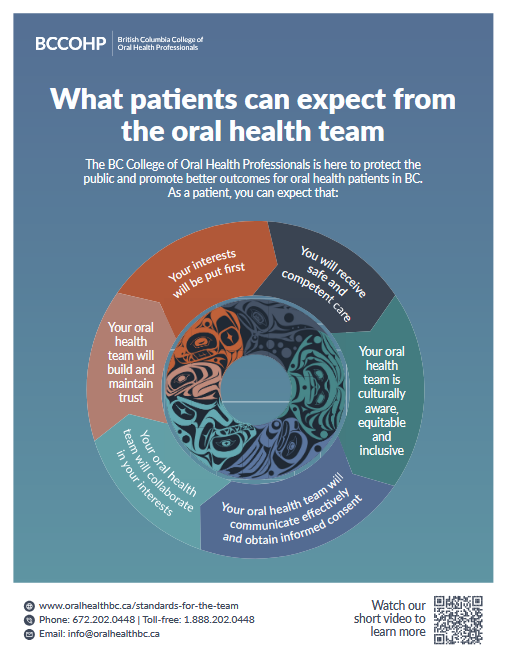
New! Printable poster for your office
We’ve created a patient-facing poster informed by the Professional Standards explaining what patients can expect from their oral health team. As oral health professionals, you are welcome to print and share it in your offices.
Learn more >>
Background
BCCOHP’s Professional Standards for the Oral Health Team came into effect on June 30, 2025. These standards are the minimum requirements for professional and ethical performance, conduct and behaviour for oral health professionals in BC. They are the core professional and ethical requirements and apply to all aspects of oral health care and all oral health professionals.
Contact us
For more information, please reach out to BCCOHP’s Professional Advisors via our contact form >>